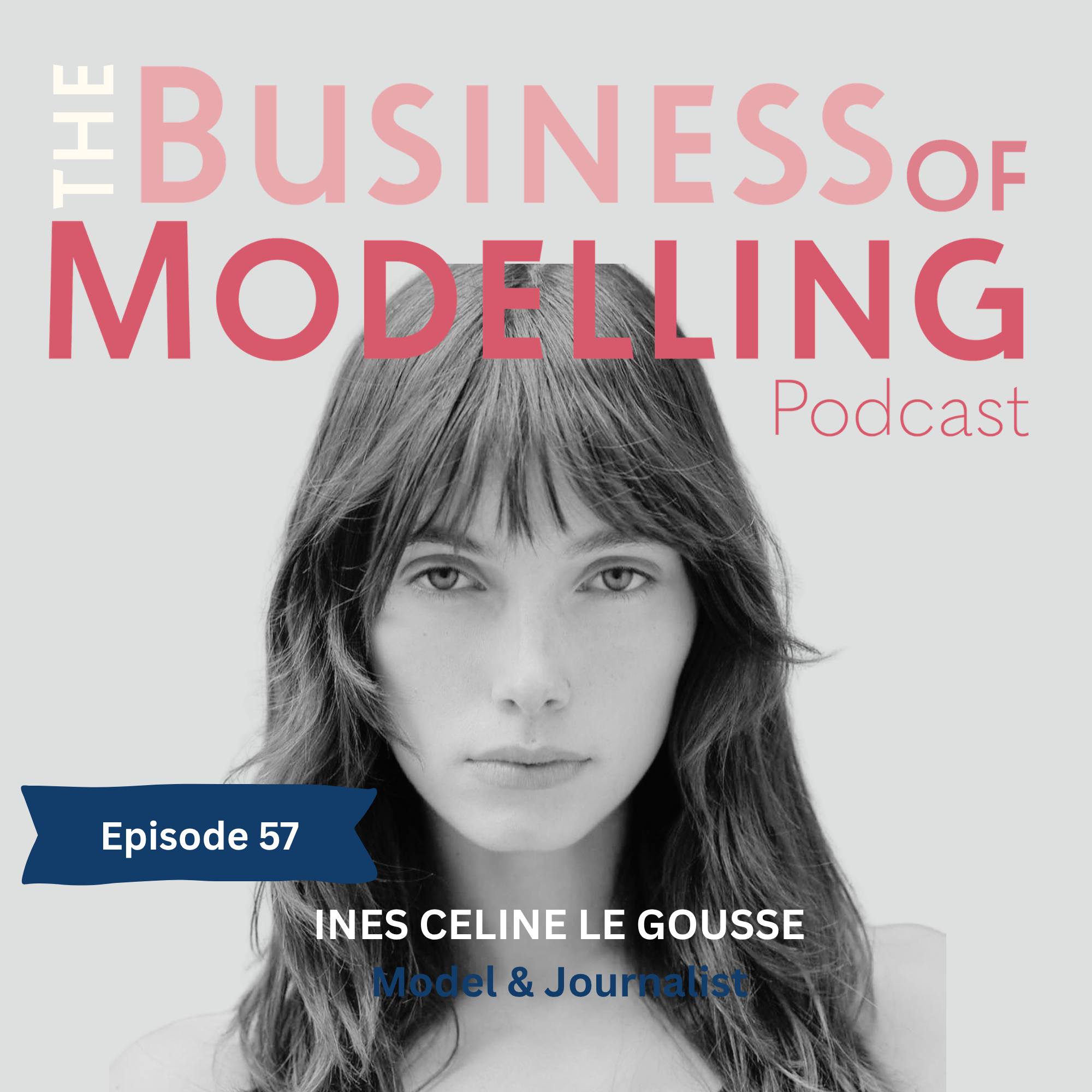
Episode 57
This week, Tessa is joined by Ines Celine Le Gousse, a model and journalist who writes about the realities of the modelling and fashion industry. In this episode, she talks about how she first came into modelling, being scouted in London, and her experience working across London, Paris, Milan and Athens.
Ines shares an honest view of what modelling can feel like behind the scenes, including the pressure around body size, sample clothes, confidence and comparison. Ines also discusses the gap between how the industry is often perceived from the outside and what the job can involve day to day.
Alongside this, Ines reflects on her move into journalism and why writing has given her a way to speak more openly about the industry. She also talks about the importance of education, support systems and having something outside modelling that gives models confidence, stability and a sense of worth.
Ines Celine Le Gousse on Body Standards, Journalism and the Reality Behind Modelling
Interview by Tessa Dewing for The Business of Modelling Podcast
Ines Celine Le Gousse is a model and journalist who writes about the realities of the modelling and fashion industry. Having worked across London, Paris, Milan and Athens, her experience gives her a clear and personal view of both the opportunities and pressures that can come with modelling. In this episode, she speaks openly about body standards, confidence, the perception of modelling from the outside, and how journalism has given her a way to examine the industry with honesty and perspective.
Starting Out
Ines first became interested in modelling while growing up in Paris. She explains that, as a tall teenager, being told she could model felt validating. “It had always been a dream of mine to be a model. But I think it came from a place of insecurity, because I was very tall – taller than all the boys.”
After taking part in Elite Model Look in France, Ines later moved to the UK for university and stopped thinking about modelling for a while. It was only after graduating and moving to London that she was scouted. “I thought I would hate to have regrets, and so I reached out, and then I got signed.”
Early Modelling Experiences
One of Ines’ first jobs was working with Victoria Beckham, which she describes as a real introduction to the intensity of the industry. “My first job was like the biggest baptism of fire. I was working with Victoria Beckham.”
She speaks about being thrown straight into fittings and the pressure of trying to understand the job while learning as she went. “There was a moment where I was doing fittings, and I was like, I’m not sure I’m cut out for this, because it was very, very long hours.”
Alongside the harder moments, Ines also reflects on the opportunities modelling gave her, including travelling and working in different markets. “I got to travel loads. I lived in Milan, Paris, Spain for a little bit, and I lived in Athens, which was actually so fun.”
The Reality Behind the Image
A key theme throughout the episode is the gap between how modelling is perceived and what the job can actually feel like day to day. Ines explains that the image people have of modelling is often very different from the reality. “The best thing about being a model is the perception that people have of you… because the job itself is the least glamorous thing I’ve ever done in my life.”
She talks honestly about the lack of control models can feel, particularly when so much depends on being selected by someone else. “You have so little agency and so little control over being picked, or what the outcome of your effort will be, that you try to control other things.”
Body Standards and Pressure
Ines speaks openly about body standards in high fashion and the pressure around size, sample clothes and fitting into expectations that are often unrealistic. She reflects on the mixed messages models can receive when their appearance is praised but also criticised. “They loved the way I represented the brand, but they didn’t want people to see that. It was very odd, very mixed messages.”
She also discusses how difficult it can be to separate your sense of self from your appearance when that appearance becomes part of your work. “It was tough to remain neutral about your appearance in an industry that monetises it, and it is your entire job.”
The conversation also touches on the wider industry narrative around inclusivity and whether that has matched the reality Ines experienced. “There was a lot of discourse around body positivity, but that was never really the case in the industry, from what I saw.”
Moving Into Journalism
Ines later studied fashion communications and journalism at Central Saint Martins, which gave her a way to look at the industry from a different angle. Writing became a way for her to process her own experience and speak more openly about what models often feel unable to say. “It was frustrating, the disparity between the glamour and the absolute opposite of glamour. And so I wanted to write about it.”
She explains that journalism gave her a sense of voice after feeling limited in what she could say as a model. “We have so little agency, and I had no voice at all as a model. It felt nice to be able to regain a bit of a voice.”
Life Beyond Modelling
Ines also speaks about why it is important for models to have something outside the industry, whether that is education, friendships, creative work or another career path. “I needed the uni degrees. I needed the friends who aren’t models. I needed that support system. I needed the experiences.”
She talks about the importance of having something that belongs to you, especially in an industry where models are often being directed, judged and chosen by other people. “It’s good to have something that is your own and that you can work on. You can be creative, or you can learn, and that’s your decision.”
What Still Needs to Change
What comes through clearly is that Ines’ experience is not only about the difficult parts of modelling, but about wanting the industry to be more honest about them. She reflects on how hard it can be for models to speak up when they are worried about losing work. “You don’t want to burn any bridges at all. If you’re a complicated model, they won’t hire you. It’s quite hard to speak up.”
Her perspective offers a direct and thoughtful look at the modelling industry from someone who has lived it and now writes about it. The episode highlights the need for better support, more realistic standards and a deeper understanding of models as people, not just images. “The best people are the people who acknowledge models as equals.”